
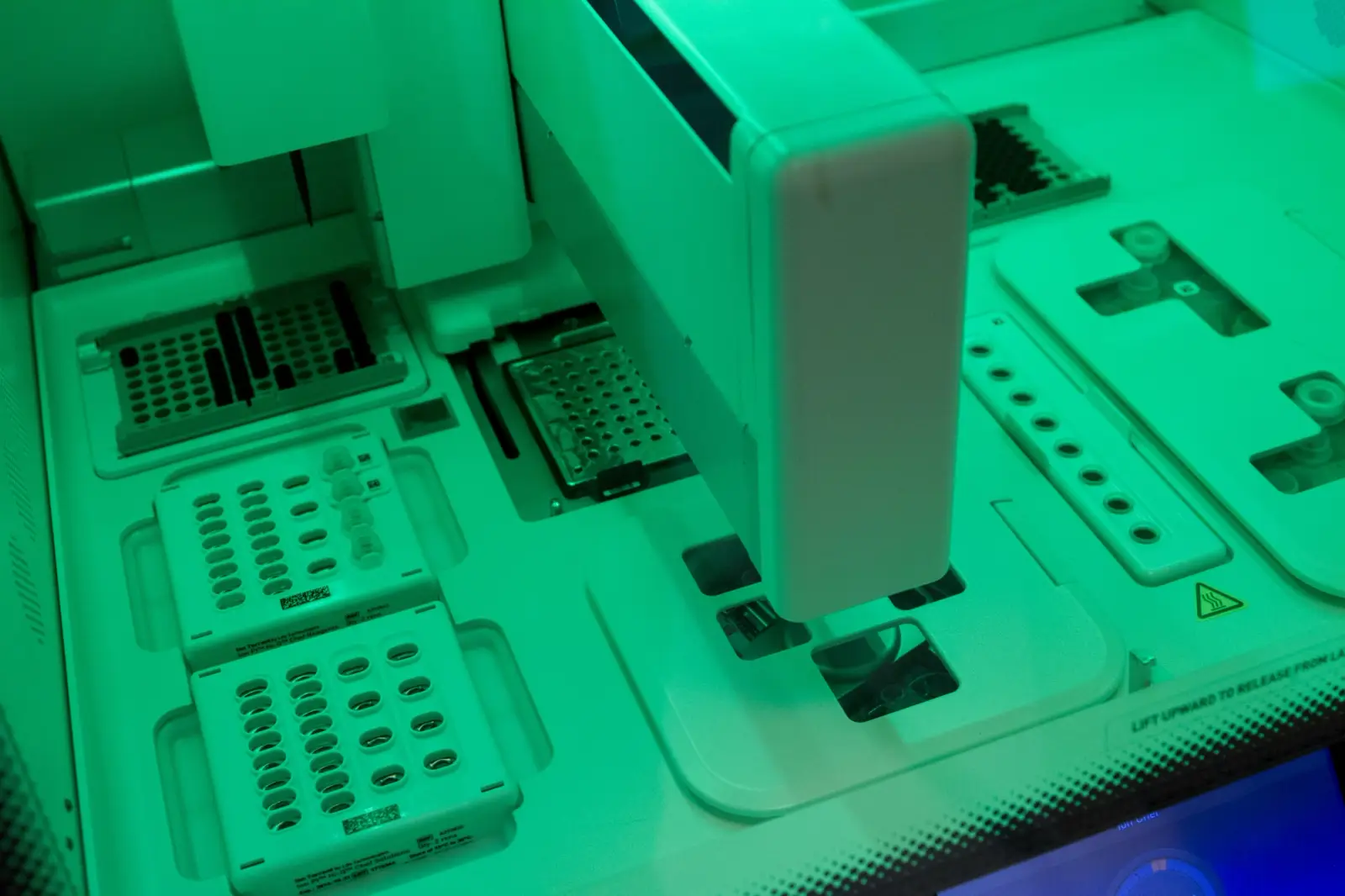

Sample prep: what happens before we sequence your DNA?
Before we can sequence your DNA we need to prepare individual molecules that can be loaded into our sequencer.
4 min read
How sequencing works
How modern instruments read a whole genome by sequencing millions of short DNA fragments at once, and why each letter is read many times over.
Reviewed by Matt Brown on 12 October 2026 · 5 min read
Your genome is about three billion letters long, written in four chemical bases: A, C, G and T. Reading it means working out the order of those letters. Next-generation sequencing (NGS) is the family of technologies that made reading a whole human genome fast and routine, by reading millions of short pieces of DNA at the same time instead of one at a time.
The first practical method, Sanger sequencing, was developed in the 1970s. It reads a single stretch of DNA, up to around a thousand letters, per reaction. It is very accurate and is still used to confirm individual results, but reading a whole genome this way means repeating it millions of times. The Human Genome Project, which used it to produce the first reference genome, took thirteen years and laboratories around the world.
NGS breaks the genome into millions of short fragments and reads all of them at once. Each fragment yields a short sequence, called a read, and a single instrument run can produce billions of them. Software then pieces the reads back together. That parallelism is what turned a decade-long project into something a laboratory can do in days.
No single read is perfect, so each position in the genome is read many times by overlapping fragments. The average number of reads covering a position is called coverage or depth. Clinical whole genome sequencing commonly aims for an average of about 30x, meaning each letter is read around thirty times, which lets real differences be told apart from occasional reading errors.
Raw reads are only the beginning. Bioinformatics software aligns each read to its place in a reference human genome, then compares your sequence with the reference to find the positions where they differ, a step called variant calling. Those variants are then annotated with what is known about them.
The method described above produces short reads, which are highly accurate and economical, and is the workhorse of whole genome sequencing. Long-read technologies read single molecules thousands of letters long. They are better at spanning repetitive regions and large structural changes, and the two approaches are increasingly used together.
Because NGS reads the genome in parallel, it is practical to sequence all of it rather than a handful of pre-chosen positions. That is the difference between whole genome sequencing and tests that look only at selected genes or known markers.
One kit, sent to your home. Your entire genome sequenced at the clinical standard used for diagnostic decisions. Physician-ready reports delivered to your Genome Manager in 6–8 weeks — permanent and updated as science advances.
Free shipping · Results in 6–8 weeks