
What is next-generation sequencing?
How modern instruments read a whole genome by sequencing millions of short DNA fragments at once, and why each letter is read many times over.
5 min read
How sequencing works
Before we can sequence your DNA we need to prepare individual molecules that can be loaded into our sequencer.
Reviewed by Matt Brown on 12 October 2026 · 4 min read
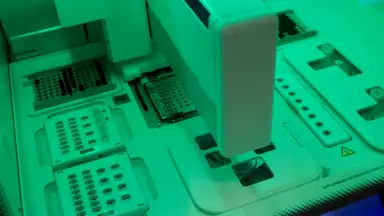
When your sample arrives at our laboratory we need to prepare it before sequencing. The process of sample preparation (prep) is considerably more involved than the sequencing step. During this process we also perform quality control to ensure that we can sequence the sample successfully.
Your sample arrives to our laboratory as whole cells: whether thats whole blood cells when you send us a blood sample, or cheek endothelial (skin) cells when you send us a saliva sample. Before we can sequence the sample, we perform an ‘extraction’. This process breaks down the cell and nuclear membrane (where your DNA is stored in your cell) so that the DNA is freely floating. This is essential as the membrane and nucleus both act to protect your DNA from chemical intruders.
Once we have extracted the DNA, we fragment it. Your DNA is safely stored as entire chromosomes which are 100’s of millions of bases long, however our sequencers can only read 1000’s of bases at a time. The fragmentation step breaks down the long stretches into multiple smaller chunks which.
One kit, sent to your home. Your entire genome sequenced at the clinical standard used for diagnostic decisions. Physician-ready reports delivered to your Genome Manager in 6–8 weeks — permanent and updated as science advances.
Free shipping · Results in 6–8 weeks