Your genetic picture changes what doctors can do.
Cancer genetics covers two distinct situations: assessing inherited risk before a diagnosis, and profiling a tumor after one. Dante handles both — with clinical-grade whole genome sequencing and a dedicated specialist at every step.
Your family history is genetic information. The question is whether you carry the same variant.
If a parent, sibling, or close relative has been diagnosed with hereditary breast cancer, ovarian cancer, colorectal cancer, or another hereditary cancer condition — you may carry the same inherited variant. The variant does not guarantee the diagnosis. But knowing whether it is present changes the clinical picture completely: what screening is appropriate, what monitoring makes sense, and what your first-degree relatives should consider testing for.
Dante Genome Test reads all 4,000+ known pathogenic BRCA1 and BRCA2 variants — not the subset covered by standard panels. It covers all genes simultaneously associated with hereditary cancer risk: Lynch Syndrome (MLH1, MSH2, MSH6, PMS2), CHEK2, PALB2, ATM, and more. One analysis. Every relevant gene.
If a variant is identified, your siblings and children can then be tested specifically for that variant — at a fraction of the cost of a full genome analysis. One answer becomes the answer for the whole family.
- Hereditary Breast & Ovarian CancerBRCA1, BRCA2
- Lynch SyndromeMLH1, MSH2, MSH6, PMS2
- CHEK2 Hereditary CancerCHEK2
- PALB2 Hereditary Breast CancerPALB2
- ATM Hereditary CancerATM
- Li-Fraumeni SyndromeTP53
- Cowden SyndromePTEN
- Hereditary Diffuse Gastric CancerCDH1
- Familial Adenomatous PolyposisAPC
- MUTYH-Associated PolyposisMUTYH
- Hereditary Ovarian CancerRAD51C, RAD51D
- Peutz-Jeghers SyndromeSTK11
- Hereditary Melanoma & PancreaticCDKN2A, CDK4
- BAP1 Tumor PredispositionBAP1
"They never added the numbers up until now when they saw the Dante Labs report."
NHS genetics at Queen Elizabeth University Hospital Glasgow accepted Dante's WGS data to identify Noonan Syndrome and a rare RUNX1 deficiency — a genetic marker associated with hereditary leukaemia risk — in a patient whose clinical picture had remained incomplete through prior investigation.
Two conditions, identified through one whole genome analysis, accepted by a named NHS institution. Thomas's case is one of multiple hereditary findings in Dante's documented outcomes where the genome data produced a clinical result that prior targeted testing had not.
Read more patient outcomesRUNX1 Deficiency — Hereditary Leukaemia Predisposition
Identified alongside Noonan Syndrome in a single WGS analysis. Both findings accepted by NHS genetics. RUNX1 deficiency had not been identified by prior targeted investigation.
Thomas's genome was analysed through Dante's standard WGS process. Clinical findings were reviewed by NHS genetics at Queen Elizabeth University Hospital Glasgow. The clinical team made the diagnostic determination. Dante's data was the input. This case illustrates that a single whole genome analysis can surface multiple clinically significant hereditary findings simultaneously.
The same clinical standard. Applied to every hereditary cancer and oncology genetics result.
Identified through the same sequencing process, the same laboratory, and the same clinical reporting standard applied to every Dante genome.
Accredited by & published in
Clinical Laboratory Improvement Amendments
Dante's results are usable in US medical decision-making — not as informational data, but as clinical-grade findings a physician can act on.
International Medical Laboratory Standard
ISO 15189 is what separates a medical lab from a testing service — not a target to reach, but an operating standard. Dante's partner laboratory holds this accreditation.
Four steps to get started.
No clinic visit required.
Order your kit
Ships within 2 business days. Free delivery worldwide.
Collect your sample
Simple saliva collection at home. Takes 5 minutes. Everything you need is in the kit.
Send it back
Pre-paid return label included. Drop it in any post box.
Access your results
Reports delivered to your Genome Manager in 6–8 weeks. Review every finding, ask questions, and share directly with your physician. Your data is stored permanently.
One test.
A lifetime of answers.
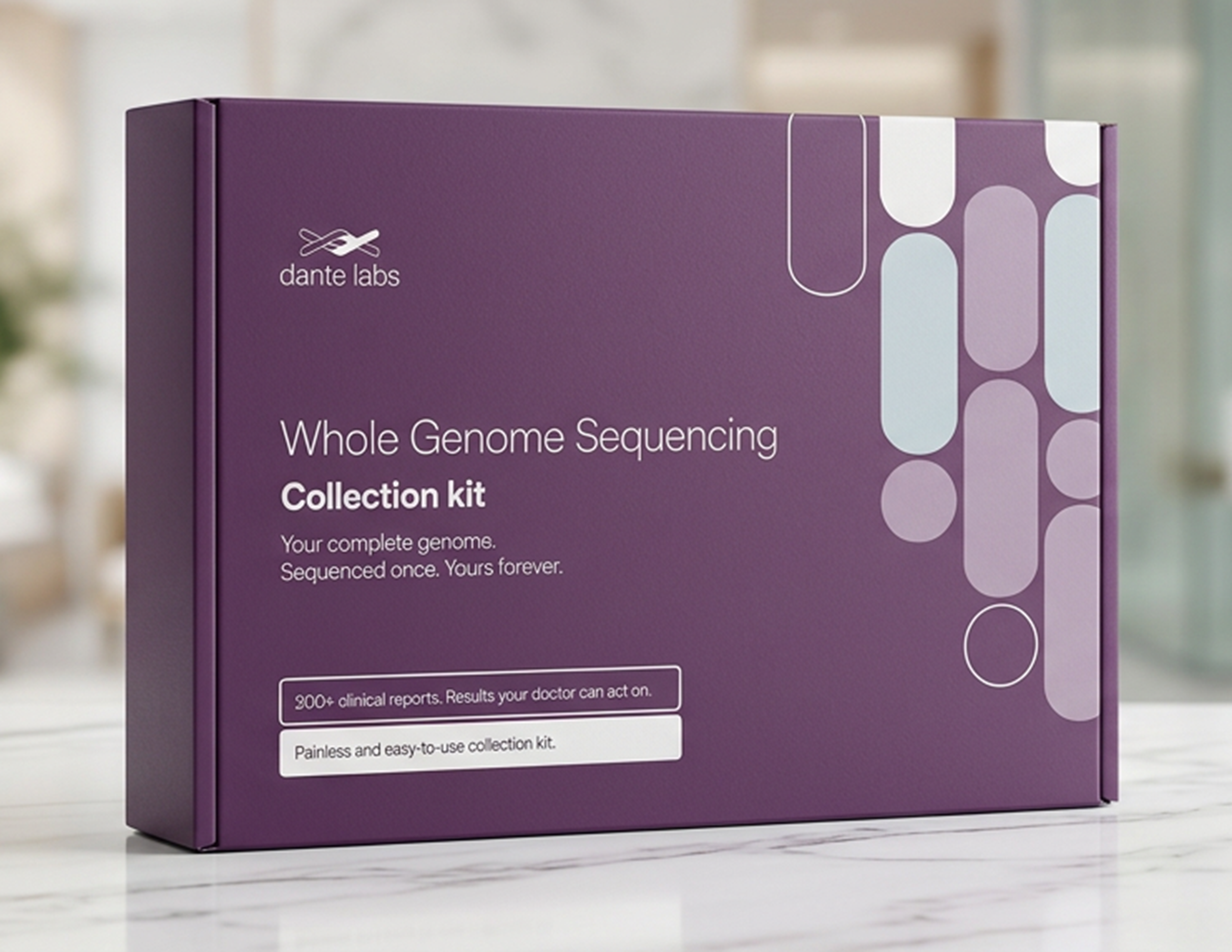
One kit, sent to your home. Your entire genome sequenced at the clinical standard used for diagnostic decisions. 200+ physician-ready reports delivered to your Genome Manager in 6–8 weeks — permanent and updated as science advances.
Ships within 48 hours · Results in 6–8 weeks
Your diagnosis may be correct. The genetic subtype that determines your treatment may be incomplete.
A cancer diagnosis identifies the condition. It may not identify the genetic subtype — and the subtype determines which treatment class is clinically appropriate for your specific tumor. EGFR-mutated, ALK-rearranged, and KRAS-mutated lung tumors require entirely different drug protocols. BRCA-mutated ovarian cancers have different treatment targets than BRCA-wild-type tumors. MSI-H cancers respond to immunotherapy; MSS cancers typically do not.
Dante's oncology genetics pathway combines germline WGS (inherited variant context) with somatic analysis (tumor-specific genetic profile). Together, these produce a complete genetic picture of your cancer: what you inherited, what changed in the tumor, and what treatment targets and clinical trial eligibility markers the data supports.
We coordinate directly with your oncologist on sample acquisition — tumor biopsy from your hospital, or liquid biopsy (blood draw) if appropriate. The process is guided by our clinical team.
Your oncologist receives a physician-ready tumor genetics report: identified variants, relevant treatment targets, and clinical trial eligibility markers based on the genetic profile — formatted for direct use in an oncology consultation and accessible through Genome Manager for secure sharing with your care team.
- Lung cancerEGFR, ALK, ROS1, KRAS, BRAF, MET
- Breast cancerBRCA1/2, HER2, PIK3CA, ESR1
- Ovarian cancerBRCA1/2, HRD, RAD51C/D
- Colorectal cancerMSI-H, KRAS, NRAS, BRAF
- Endometrial cancerMMR, POLE, PIK3CA
- Pancreatic cancerBRCA2, PALB2, KRAS
- Prostate cancerBRCA1/2, ATM, CDK12
- MelanomaBRAF, NRAS, KIT, CDKN2A
"Two years before my diagnosis, I had already sequenced my genome. When cancer came, that data was there."
Jennifer sequenced her whole genome with Dante in 2019. Two years later, she was diagnosed with breast cancer.
When oncology treatment was being planned, her clinical team accessed the pharmacogenomics analysis from her existing genome data. The analysis identified that the standard chemotherapy drug she had been prescribed would cause serious adverse effects due to her specific genetic profile.
An alternative drug was selected — a better fit for her genetic makeup. Treatment began immediately, without the time lost to a failed first attempt. The genome data from 2019 was the asset that made this decision possible before treatment started.
Read more patient outcomesPharmacogenomics — Chemotherapy Incompatibility
Pre-existing genomic data flagged a serious adverse reaction risk to the prescribed chemotherapy drug. An alternative agent was selected before treatment began — avoiding a failed first attempt.
Jennifer's pre-existing genome data, sequenced two years before her cancer diagnosis, provided her clinical team with pharmacogenomics information at the moment it was needed. The treatment decision was made by her oncologist. Dante's data was the clinical input. This case demonstrates the permanent value of genomic data generated at any point prior to a clinical event.
The same clinical standard. Applied to every hereditary cancer and oncology genetics result.
Identified through the same sequencing process, the same laboratory, and the same clinical reporting standard applied to every Dante genome.
Accredited by & published in
Clinical Laboratory Improvement Amendments
Dante's results are usable in US medical decision-making — not as informational data, but as clinical-grade findings a physician can act on.
International Medical Laboratory Standard
ISO 15189 is what separates a medical lab from a testing service — not a target to reach, but an operating standard. Dante's partner laboratory holds this accreditation.
Four steps from first contact to clinical report.
Contact us
Tell us about your diagnosis and the clinical question you are trying to answer. A specialist responds within 1 business day.
Clinical review
We review your diagnosis and confirm the appropriate pathway — somatic analysis, germline WGS, or both.
Sample coordination
We coordinate with your hospital for tissue biopsy or liquid biopsy. No action required from you beyond your existing care pathway.
Report to your oncologist
A physician-ready tumor genetics report — identified variants, treatment targets, trial eligibility markers — delivered via Genome Manager for secure sharing with your care team.
Start with a conversation.
Our clinical specialists will explain the testing process, confirm the right pathway for your specific situation, and answer your questions — before you commit to anything.
No purchase required.